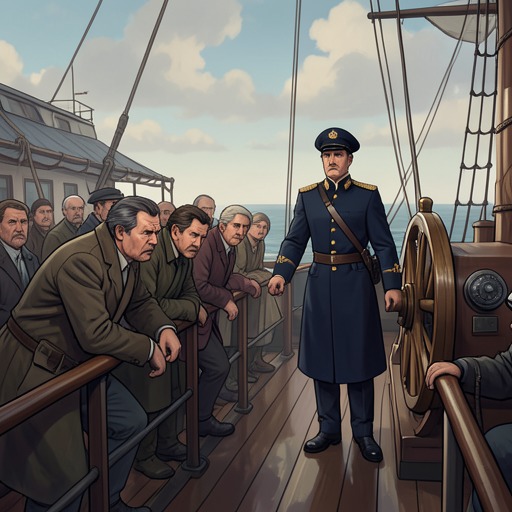
Kristina's life-threatening nasal hemorrhage
The EmigrantsKristina's life-threatening nasal hemorrhage aboard the Charlotta brings the voyage's accumulated sickness to an immediate crisis: weakened by a prolonged illness and barely able to eat, she loses enough blood that Captain Lorentz believes she may die. Karl Oskar remains at her side and tries to follow the captain's instructions; when the bleeding stops, hope returns, though Danjel misreads the moment and announces that she is dead.
Background: Illness During the Crossing
The hemorrhage comes after weeks in which illness has steadily diminished Kristina's strength. Earlier aboard the Charlotta, she had discovered that her clothes were infested with body lice. Finding them throughout the seams and folds of her wool garments, and seeing the marks they had left on her skin, she was overcome and began to cry. This episode establishes the shipboard conditions in which the later crisis unfolds: the emigrants live close together, and sickness and physical discomfort are persistent features of the passage.
Kristina's later illness is identified as scurvy, also called ship-sickness. She fears that the disease is life-threatening, and its name itself seems to her to suggest decay and contamination. The narrative does not make the hemorrhage an isolated misfortune: it follows a voyage during which other passengers have died and several people have been gravely ill. In the hold, the number of passengers has decreased by three in the preceding week, all adults who died of ship-sickness.
A Voyage Marked by Doubt and Declining Health
Illness on the Charlotta is experienced not only as bodily suffering but also through religious belief. During a storm, Inga-Lena admits to Danjel that she had doubted whether the teachings of Åke Svensson would protect believers from seasickness. Her doubt began while she was cooking and felt she might vomit as the ship was tossed by the waves. Danjel interprets the doubt as a temptation, and the exchange shows how the passengers' faith shapes their understanding of sickness without preventing it.
Inga-Lena later suffers a prolonged decline: dizziness and headaches, fainting spells during cooking or other heavy chores, and weeks of severe bowel trouble that leave her weak. She confides her fear to Kristina, wondering whether she has caught ship-sickness. Kristina has watched her continue tending Danjel and their children without rest, even when she is gaunt and struggles to walk. The account of Inga-Lena's illness provides a parallel to the danger Kristina faces: in both cases, sustained work and shipboard disease press upon bodies already made vulnerable by the crossing.
The Hemorrhage and Its Treatment
When Kristina begins bleeding, Karl Oskar is nearby and comes to her sleeping place. A quart bottle holding a piece of candle serves as a lamp. In its flickering light, he sees that blood has spread across her nightshirt and that the cotton she has placed in her nostrils has soaked through. She explains that she had thought she had caught cold, then realized that her handkerchief was full of blood. She has lain still, tried cotton, and waited, but the bleeding has continued.
Kristina has been confined to bed for several days and has scarcely eaten. Her weakness leaves her with little reserve when the hemorrhage begins. Karl Oskar recognizes the danger, while Captain Lorentz, seeing her condition and the amount of blood lost, judges that she may not survive. He also recognizes that she has suffered from scurvy for a long time. The crisis thus links her immediate loss of blood to the longer illness that has weakened her during the voyage.
Lorentz nevertheless acts. He sends Karl Oskar for a bucket of fresh seawater, wets towels, and places them as cold packs around Kristina's head. He binds additional towels tightly around her limbs, near the elbows and knees, intending to retain what blood remains there. He instructs Karl Oskar to keep her lying still on her back and to change the wet towels around her head every hour. His measures are limited, but they give Karl Oskar concrete work to do while the outcome remains uncertain.
A Reprieve and a Misunderstanding
Later, Karl Oskar notices that blood is no longer flowing from Kristina's nostrils. He had been unable to see clearly in the dark and feared that striking a light might wake her; by the time he realizes the bleeding has stopped, the change may have happened hours earlier. The cessation brings him intense relief and reinforces his conviction that one must try whatever can be done, even when the outcome is uncertain.
Danjel approaches and says that Kristina is dead. Karl Oskar rejects the announcement and answers that she lives, believing that the stopped bleeding means she may survive. The scene closes on a sharp difference between Danjel's interpretation and Karl Oskar's hope. The bleeding has stopped, but the evidence here does not establish Kristina's final recovery; the immediate ending is a reprieve shadowed by uncertainty.
Illness During the Crossing
Illness aboard the Charlotta was understood through both physical symptoms and religious belief. During a storm, Inga-Lena admitted to Danjel that she had doubted whether the teachings of Åke Svensson would protect believers from seasickness. The doubt arose while she was cooking in the ship’s cookhouse, as the waves tossed the vessel and she felt she might vomit. Danjel understood her uncertainty as a temptation, an interpretation that reveals how faith shaped the passengers’ responses to illness without guaranteeing their safety from it.
Inga-Lena’s health later declined over many weeks. After her seasickness passed, she suffered dizziness and headaches, fainted while cooking or doing heavy work, and endured prolonged bowel trouble that left her increasingly weak. She confided her worry to Kristina, including her fear that she might have contracted ship-sickness. Kristina had watched her continue caring for Danjel and their children without rest, even as she grew gaunt and struggled to walk. Her decline forms a parallel to Kristina’s crisis: both women faced persistent illness while the demands of life aboard ship continued.
Kristina’s own illness is identified as scurvy, also called ship-sickness. She feared it was life-threatening, and the name seemed to her to evoke decay and contamination. In the week before the hemorrhage, three adult passengers had died of ship-sickness, and the hold had begun to feel roomier as a result. Against that wider pattern of illness and death, Kristina’s bleeding becomes more than an isolated emergency: it is the acute crisis of a body already weakened by the crossing.
The Hemorrhage and Its Treatment
When Kristina begins bleeding, Karl Oskar is nearby and comes at once to her sleeping place. A quart bottle with a piece of candle in its neck provides light. He sees that blood has spread across her nightshirt and that the cotton she put in her nostrils is soaked through. Kristina explains that she first thought she had caught cold; after blowing her nose, she saw that her handkerchief was full of blood. She has lain still, tried cotton, and waited, but the bleeding has continued.
For several days Kristina has been confined to bed and has scarcely eaten. Her weakness leaves her with little reserve when the hemorrhage begins. Karl Oskar understands that her life is in danger, and Captain Lorentz, seeing her condition and the amount of blood lost, believes she may not survive. He recognizes that she has suffered from scurvy for a long time, connecting the sudden emergency to the illness that has steadily weakened her during the voyage.
Lorentz nevertheless does what he can. He sends Karl Oskar for a bucket of fresh seawater, wets towels, and places them as cold packs around Kristina’s head. He ties additional towels tightly around her limbs near the elbows and knees, intending to keep the remaining blood there. Before leaving, he instructs Karl Oskar to keep her lying still on her back and to change the wet towels around her head every hour. The treatment offers no assurance of recovery, but it gives Karl Oskar practical duties while the outcome remains uncertain.
A Reprieve and a Misunderstanding
Later, Karl Oskar noticed that blood was no longer flowing from Kristina’s nostrils. During the night he had been unable to see clearly and had feared that lighting a candle might wake her; the bleeding may already have stopped hours before he recognized the change. His relief rested on that small, uncertain sign. Remembering that one must do whatever one can, he believed that the effort to help might still matter even when the outcome could not be known.
Danjel approached him, pale after the night’s vigil, and said that Kristina was dead. Karl Oskar refused the conclusion: the bleeding had stopped, he believed, and she might survive. Their opposed readings leave the scene suspended between hope and feared loss. The immediate crisis has eased, but this moment does not establish Kristina’s eventual recovery; it ends with her condition still uncertain.